Everton
The Drover's WifeEverton grows from a troopers’ outpost into a stock-route town, but its development is inseparable from the dispossession that made settlement possible. First proposed as Cresthill, it becomes a place of markets, government offices, and planned prosperity while Indigenous people are driven from their homelands, subjected to colonial violence, and treated as targets for dispersal. The town’s history joins material progress to the coercive power that secured it.
From outpost to proposed town
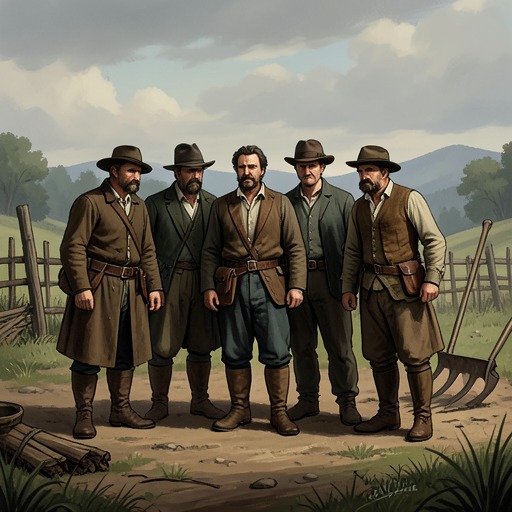
The settlement begins as Cresthill, an outpost in the alpine high country of New South Wales. As more farmers and settlers arrive, Charles Edwards argues at district meetings that a town should be established along the major stock route. He offers to help finance it, while insisting that Aboriginal people must be managed and dispersed first. The meetings sanction the proposal, and the decision is applied rapidly to the clans of the alpine country.
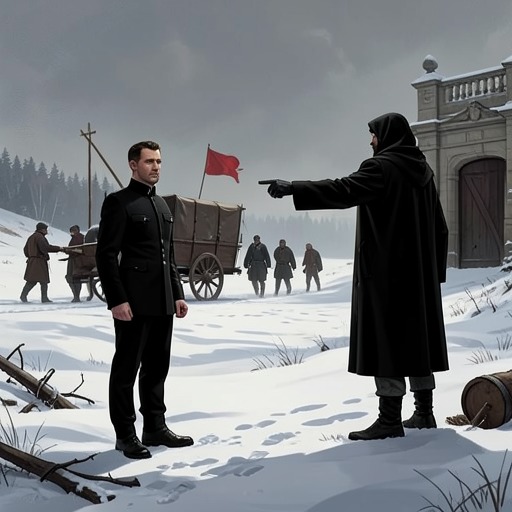
This history is recalled against the seizure of Ngarigo and neighbouring peoples’ land. Settlers put up fences, drive people away from their homelands, and disrupt the seasonal movement by which they had lived. Under the settlers’ asserted authority, Aboriginal people are exposed to shooting or dispersal; survival increasingly means remaining out of sight. The town’s foundation is therefore not a neutral response to commerce: it is part of a colonial transformation of land and mobility.
The Edwards family and the town’s growth
The Edwards family’s money and influence help turn the outpost into a commercial centre. As the family prospers, the town plan slowly takes shape. It is initially to be named Evelyn, after the Edwards matriarch, and its role as a stock route and sale destination makes a permanent town seem increasingly necessary. On sale days, people come from across the district.
The later development is driven by Frank Neville Charles Edwards, whose wool business links local production to overseas markets through Melbourne. The enterprise supports farmers and drovers as well as the Edwards fortune, but a worldwide economic depression weakens it. Everton’s all-male council prefers the masculine name Everton to Evelyn, and the town’s final development becomes contingent on keeping Frank and his capital in the district. Although Frank and his wife Ulla consider leaving, he remains committed to his dying grandfather’s promise to complete the town and return to the property.
Construction proceeds around the older jailhouse, troopers’ quarters, Stanlow Inn, general store, and postal house. Draught horses haul telegraph poles into line along the new street. Frank makes a new saleyard a priority, intending it to be ready and named before the next major sale day; the planned Charles Edwards Saleyards embody the family’s effort to anchor the district’s economic future in its own name.
Law, arrival, and racial control
When Nate Clintoff accepts the position of peacekeeper, Everton is described as a newly formed town that had been a troopers’ outpost in the Snowy Mountains. His instructions direct him to the southern end of town, where he is to collect keys to his home and to the office, jail, and troopers’ quarters. Father McGuinness is to provide further directions and is treated as the unofficial mayor. The arrangement gives the growing settlement a visible civic and policing structure, while showing how much local authority rests with established figures.
The town’s order is shaped by the same assumptions that attended its founding. Nate is told that most of the people described by settlers as troublesome have been driven higher into the mountains, while others are confined to a newly established camp or reserve at Cohens Lake, renamed Blackfellows Lake. Later, Yadaka explains the danger faced by Aboriginal people in the district: arrest, imprisonment, forced movement, and a policy of shooting people on sight. In Everton, the language of public order coexists with a racial system that denies Indigenous people safety and freedom of movement.
A town’s reach into private lives
Everton’s authority reaches beyond its streets and institutions. Molly Johnson weighs the danger of Yadaka going into town to seek a reward: she fears that his presence could bring troopers to her home. A proposed check on her welfare is deferred for two days while troopers are summoned from another outpost, and Nate regards his responsibility as ending once they have made that visit. The delay exposes the limits of official concern even as the town’s police network extends into isolated country.
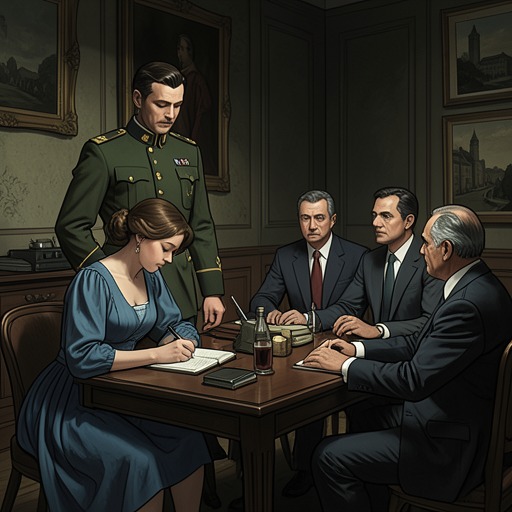
The threat becomes more direct when Miss Shirley describes Molly’s children as octaroons and urges their removal in the name of their safety. Judge Eisenmangher signs the authorization. Danny, who hears the exchange, understands that the decision could separate the children from their mother, whom he knows as their protector. The episode makes Everton’s legal authority concrete: racial classification is converted into official paperwork, and the language of protection authorizes an intervention against a family.
That logic continues into Molly’s trial. The Crown presents her Aboriginal heritage, her mother’s history, and Yadaka’s influence as grounds for interpreting her actions as generational hatred and revenge. An all-male jury hears the case, while Danny—the only witness to Molly’s truth—is absent. Nate recognizes the hearing’s bias but cannot undo its outcome; Louisa’s efforts to secure legal protections for battered wives cannot take effect in time to help Molly. Everton thus gathers the novel’s competing claims to law and justice into one place: the institutions that administer the town also expose the unequal value assigned to its residents’ testimony and lives.
Meaning within the narrative
Everton’s development is presented through recurring contrasts between settlement and dispossession, civic order and racial coercion, official protection and family care. Its commercial life—stock sales, wool exports, streets, telegraph lines—depends on a transformation of the country that pushes Indigenous people from their land and constrains their movement. The town is not merely a backdrop to the Johnson family’s danger; its history and institutions help produce that danger.
The novel also places the town’s administrative reach against forms of knowledge and belonging that do not originate there. Yadaka describes seasonal movement from the mountains northward when the first mist rises in the valleys, a pattern grounded in Indigenous knowledge of place. Against this cyclical relationship with Country, Everton represents an imposed order that fences land, concentrates people in reserves, and claims authority over children. Its material growth is real, but so is the cost on which that growth rests.